Understanding what is the difference between fixed and sliding supports is crucial in mechanics and structural engineering. These supports are vital in ensuring the stability of structures. Fixed supports restrict all movement, while sliding supports allow for horizontal movement.
Fixed supports provide a robust connection to the ground. They resist both vertical and lateral forces, making them ideal for structures that need stability. However, they can induce stress in materials during thermal expansion. On the other hand, sliding supports offer flexibility. They permit movement and reduce internal stresses. Yet, they may compromise stability in certain conditions.
Both support types have their pros and cons. Selecting the right one often depends on the structure's needs. Understanding their differences is not always straightforward. Engineers must consider various factors before making a choice.
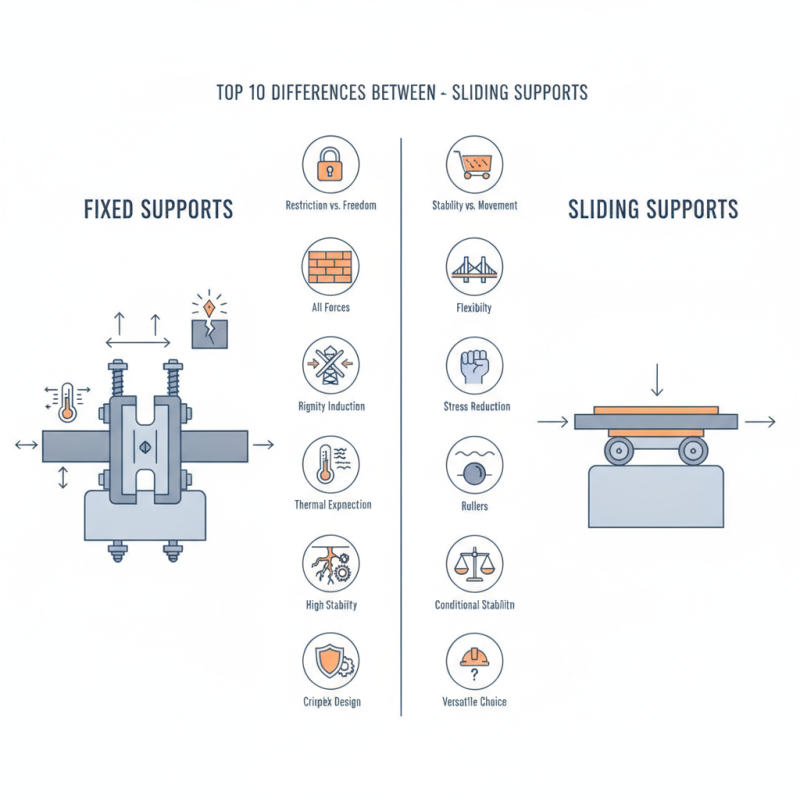
In structural engineering, fixed and sliding supports play crucial roles in load transfer mechanisms.
Fixed supports can resist movements in all directions. They provide stability by transferring loads directly to the foundation.
This mechanism helps prevent excessive movement or rotation under load.
Engineers often choose fixed supports for essential structures like bridges and tall buildings.
The inability to move creates challenges during thermal expansion.
Fixed and sliding supports play crucial roles in structural engineering. Their differences directly impact structural stability and stress distribution. Fixed supports provide full restraint, preventing any rotation and translation at the structure's end. In contrast, sliding supports accommodate movement in one direction, allowing structures to adapt to thermal expansion and contraction. This flexibility is vital, especially for bridges and large buildings where temperature changes can cause significant shifts.
Research from the National Institute of Standards and Technology (NIST) reveals that incorrect support selection can lead to structural failures. A study showed that 30% of structural failures were related to inadequate support types. Fixed supports tend to concentrate stress at their connections, increasing the likelihood of local failures. Conversely, sliding supports distribute stress more evenly, minimizing risk. However, they may lead to instability if not designed correctly, especially under lateral loads.
It's essential to consider the specific use case when choosing support types. For instance, fixed supports are preferable in high-stress areas, while sliding supports are better for structures needing flexibility. Striking the right balance is critical for long-term performance and safety. Many engineers still grapple with determining the best mix to ensure reliability while accommodating movement, highlighting a need for ongoing education and research.
Fixed supports provide resistance to vertical and horizontal forces. They prevent any movement at the connection point. Sliding supports, on the other hand, allow horizontal movement while resisting vertical displacement. This key difference plays a crucial role in structural design.
Displacement control is where these supports shine. Fixed supports keep structures stable against shifting loads. However, they can be problematic. They might lead to stress concentrations, especially in materials that are prone to fatigue. In contrast, sliding supports offer flexibility. This flexibility can be beneficial in areas with varying thermal expansion. But it can also introduce challenges, like misalignment during installation.
Tips: Always consider the site conditions when choosing supports. Regular inspections can help identify potential issues early. Ensure that your design accounts for realistic movement scenarios to enhance safety and performance.
The performance of fixed and sliding supports is significantly influenced by the material properties used in their construction. For instance, steel supports exhibit high strength but may suffer from corrosion if unprotected. Studies show that materials with enhanced corrosion resistance can improve support longevity. In contrast, concrete provides good compressive strength but can be brittle. Research indicates that using composite materials in innovative designs enhances ductility and reduces failure rates while supporting structures under dynamic loads.
Temperature fluctuations also affect material performance. As temperature increases, many materials expand, altering the support mechanisms. For instance, thermoplastics show considerable thermal expansion, which can lead to misalignment in sliding supports. This issue can cause unexpected stress concentrations, ultimately impacting the entire structure. Additionally, the stiffness of the material plays a crucial role. Fil elastomers, while flexible, may not sustain heavy loads compared to stiffer materials, underscoring a need for balance in material selection.
Understanding these nuances can lead to better design decisions. Engineers must consider material behavior under different loads and conditions. Failure to account for these factors can lead to costly repairs or even catastrophic failures. Continuous material innovation seeks to address these challenges while maintaining user safety and structural integrity.
This chart illustrates the key differences between fixed and sliding supports across various functionality aspects. The data reflects aspects such as load capacity, movement restriction, and material compatibility, providing insights into their performance in engineering applications.
Fixed and sliding supports play crucial roles in engineering design. Fixed supports provide absolute stability, constraining all movement. They handle vertical and horizontal loads effectively. Engineers often choose fixed supports for structures needing rigidity, like bridges or buildings. However, these supports can limit movement and may induce stress if thermal expansion occurs.
In contrast, sliding supports allow for some movement. They accommodate thermal expansion and contraction without generating excessive stress. This makes them suitable for pipelines or rail tracks, where temperature changes are expected. Nonetheless, sliding supports may be less stable and can lead to misalignment if not properly designed. Engineers must weigh these factors carefully in their designs, as choosing the wrong support can lead to structural failure or costly repairs. Understanding these applications and limitations is key to effective engineering design.
| Feature | Fixed Support | Sliding Support |
|---|---|---|
| Movement | No movement allowed | Allows translational movement |
| Reaction Forces | Resists all forces and moments | Resists vertical forces only |
| Use Case | Used in rigid structures | Used in structures needing flexibility |
| Types of Structures | Bridges, buildings | Pipelines, railways |
| Complexity | More complex design | Simpler design |
| Cost | Generally higher | Generally lower |
| Durability | High durability | Moderate durability |
| Installation | Requires precise alignment | Easier and faster installation |
| Thermal Expansion | Restricts expansion | Accommodates expansion |
| Example Materials | Concrete, steel | Plastics, metals |
: Fixed supports resist movement in all directions, providing stability. Sliding supports allow movement, accommodating thermal expansion.
Fixed supports prevent rotation and translation, helping avoid local failures but can concentrate stress at connections.
Sliding supports offer flexibility but may lead to instability, particularly if not designed to manage lateral forces.
Incorrect support selection can lead to structural failures. Each type has advantages and disadvantages to consider.
Material strength and resistance to corrosion are crucial. More durable materials may enhance support longevity and safety.
Temperature changes can lead to expansion, causing misalignment. This misalignment may create unexpected stress concentrations.
Composite materials can enhance ductility and reduce failure rates, helping supports withstand dynamic loads better.
Engineers must evaluate load types and structural needs. Finding the right mix is essential for safety and reliability.
Many may overlook specific project needs, leading to potential structural issues. Continuous learning is necessary in this field.
Ignoring material behavior can result in costly repairs or catastrophic failures. Understanding these factors is critical for safety.
The article "Top 10 Differences Between Fixed and Sliding Supports" delves into the fundamental distinctions in load transfer mechanisms between these two support types. A key aspect is how fixed supports provide greater stability and rigid support, resulting in a more uniform stress distribution throughout a structure. In contrast, sliding supports allow for movement, accommodating thermal expansion and contraction, but may lead to increased displacement under load.
Additionally, the performance and functionality of these supports are influenced by material properties, which can vary significantly depending on the application. The comparative analysis highlights how fixed supports typically offer better control over displacement, while sliding supports introduce flexibility. Understanding what is the difference between fixed and sliding supports is crucial for engineers when designing structures, as it impacts both stability and performance in various engineering applications.

Ampy Pipe