Corrosion in pipe supports rarely begins with dramatic rust. It often starts beneath a clamp, around a weld, or inside a small water pocket. Learning how to avoid corrosion in pipe supports requires more than selecting a durable coating. It requires understanding moisture, temperature, chemicals, movement, and maintenance conditions together.
Mars G. Fontana, a respected corrosion engineer, wrote, “Corrosion is the deterioration of a material, usually a metal, by reaction with its environment.” That principle remains practical today. A carbon-steel support beside a cooling-water line may face condensation every morning. A damaged coating can then expose bare steel, while trapped dirt keeps the surface wet for hours. Small details matter.
Good design begins with drainage, ventilation, and clean contact surfaces. Avoid horizontal ledges where water can remain. Seal or isolate dissimilar metals when galvanic corrosion is possible. Use compatible coatings, protective pads, or hot-dip galvanizing according to the operating environment. Check welds and crevices carefully. Inspect after installation, not only during annual shutdowns.
The process is not perfect. A coating may look intact while corrosion develops underneath it. A stainless-steel clamp may still fail if chlorides concentrate nearby. Records can also be incomplete. That weakness deserves attention. Reliable corrosion control combines material selection, installation discipline, regular inspection, and prompt repair.
This guide explains practical choices for pipe supports in outdoor, marine, chemical, and high-temperature areas. It focuses on visible warning signs, hidden moisture paths, coating damage, and inspection habits. The safest solution is rarely the most expensive one. It is usually the solution that fits the environment and remains maintainable.
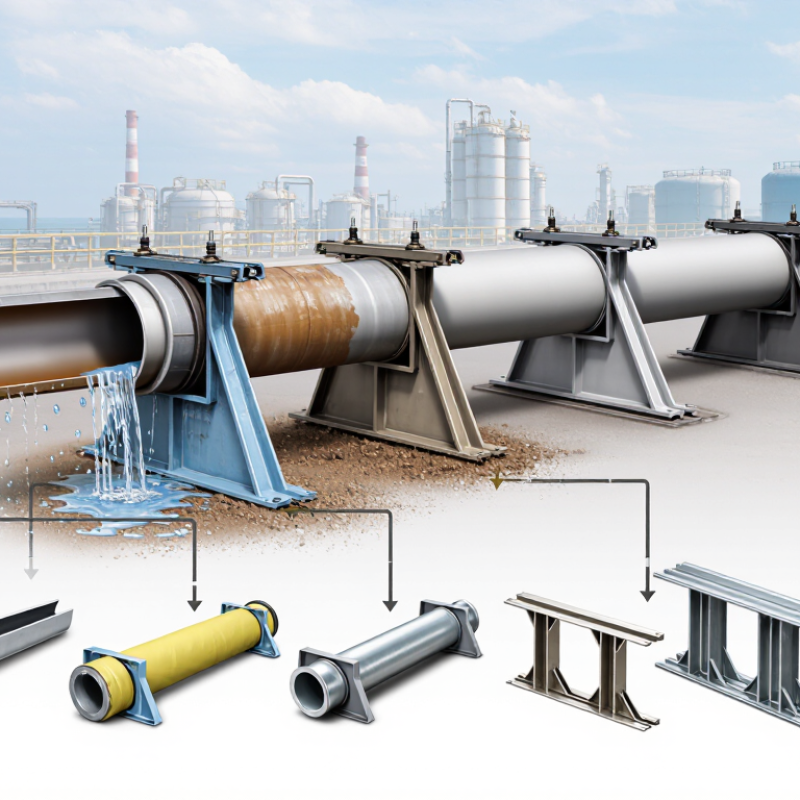
How to Avoid Corrosion in Pipe Supports
Corrosion risks in pipe supports often begin where water remains unseen. Moisture collects between clamps, saddles, and pipe surfaces. Chlorides can accelerate attack in coastal or chemical-processing environments. Dissimilar metals may create galvanic corrosion at bolted connections. Damaged coatings expose small areas, but the damage can spread beneath the surrounding film. In field inspections, support contact points are frequently harder to examine than open pipe sections. That hidden condition deserves attention.
Good design starts with drainage, suitable material selection, and separation of incompatible metals. Support geometry should prevent water pockets and allow inspection access. Protective coatings need proper surface preparation, especially around welds and sharp edges. Insulating components can reduce galvanic contact, but they must not trap moisture. During maintenance, technicians should check clamps, welds, bolts, and contact marks. Ultrasonic thickness measurements can help confirm whether external corrosion has reduced pipe-wall integrity. Records should include photographs, locations, coating condition, and measured thickness.
Small defects matter.
Cleaning schedules should reflect the actual environment, not only the original design assumptions. Washdown water, condensation, and chemical vapors may change site conditions over time. No inspection plan is perfect. I have seen clean-looking supports conceal deep corrosion beneath a tight clamp. That mistake is easy to repeat. Qualified personnel should compare findings with applicable engineering codes and the site’s corrosion-control procedure. Fresh coating alone cannot correct poor drainage or trapped contamination.
Selecting Corrosion-Resistant Support Materials
Pipe supports fail quietly. Moisture collects beneath clamps, coatings crack, and corrosion expands around bolt holes. The NACE IMPACT study estimated global corrosion costs at about US$2.5 trillion annually, equal to roughly 3.4% of global economic output. Material selection deserves early attention.
For outdoor carbon-steel piping, hot-dip galvanized supports can provide practical protection when coating thickness suits the exposure. In coastal or chemical environments, stainless steel may perform better, but grade selection matters. Chlorides can attack unsuitable stainless alloys, especially inside wet crevices. Fiberglass-reinforced polymer supports avoid many galvanic reactions and offer low maintenance. However, they need careful checks for ultraviolet exposure, temperature, fire performance, and load capacity.
Small details decide service life.
Tips: Separate dissimilar metals with non-absorbing isolators. Avoid support designs that trap water. Specify drainage gaps beneath saddles. Inspect damaged coatings before installation, not after commissioning. The ISO 12944 standard can help classify atmospheric exposure and select protective coating systems. Field inspections often show a missed interface, rather than the support body, as the first corrosion point. That observation is easy to overlook. It should encourage engineers to review clamps, fasteners, welds, and cut edges as one system. Manufacturers’ data must be checked against actual temperature, chemicals, vibration, and maintenance access.
| Support Material or Protection Method | Typical Corrosion Resistance | Suitable Environments | Key Advantages | Important Limitations | Recommended Selection Practice |
|---|---|---|---|---|---|
| Hot-dip galvanized carbon steel | Good in mildly to moderately corrosive atmospheric conditions | Indoor plant areas, dry outdoor locations, and general industrial atmospheres | Zinc coating provides sacrificial protection; generally economical and mechanically strong | Performance decreases in persistent moisture, acidic or alkaline exposure, and salt-laden atmospheres | Specify coating thickness according to the exposure category; repair damaged areas and avoid water-trapping details |
| Stainless steel, austenitic grades | Very good general atmospheric resistance; grade-dependent resistance to chlorides | Food, pharmaceutical, clean utility, humid, and outdoor environments | Durable, cleanable, and resistant to many aqueous environments | Chlorides can cause pitting and crevice corrosion; dissimilar-metal contact may cause galvanic corrosion | Select the grade based on chloride level, temperature, chemicals, and crevice conditions; use compatible fasteners and isolation where needed |
| Aluminum alloy | Good in many atmospheric environments; vulnerable to certain chemicals and galvanic attack | Light-duty supports, exterior installations, and applications where low weight is important | Low density, naturally protective oxide film, and good ease of installation | Lower strength and stiffness than steel; can corrode when coupled directly to more noble metals in an electrolyte | Verify load capacity and provide electrical isolation from dissimilar metals, especially in wet or salt-contaminated areas |
| Fiber-reinforced polymer (FRP) | Excellent resistance to many chemicals, moisture, and saltwater atmospheres | Chemical plants, wastewater facilities, marine areas, and high-humidity locations | Does not rust; lightweight; electrically nonconductive; low maintenance | Properties vary by resin and fiber; may have lower temperature capability and different fire performance than metals | Confirm resin compatibility, temperature rating, fire requirements, UV exposure, and structural load data before selection |
| Epoxy- or polymer-coated carbon steel | Good when the coating remains continuous and properly bonded | Industrial interiors, damp areas, and selected chemical-service applications | Combines steel strength with a barrier against water, oxygen, and chemicals | Scratches, impact, poor surface preparation, and coating holidays can initiate underfilm corrosion | Use suitable surface preparation, specified dry-film thickness, edge treatment, and field repair procedures |
| Duplex stainless steel | Very good resistance to chloride pitting, crevice corrosion, and stress corrosion cracking when correctly specified | Marine, offshore, process, and high-chloride environments | High strength-to-weight ratio and strong resistance in demanding chloride service | Higher material and fabrication requirements; incorrect welding or heat treatment can reduce corrosion performance | Use qualified fabrication procedures, compatible weld materials, and appropriate cleaning or passivation practices |
| Nonmetallic isolation pads and liners | Reduces crevice and galvanic corrosion at the pipe-support interface | Mixed-metal assemblies, wet locations, and supports exposed to condensation | Separates dissimilar metals and can reduce water retention and coating damage | May creep, wear, absorb chemicals, or degrade under high temperature and loading | Check compressive strength, temperature range, chemical compatibility, thickness, and long-term dimensional stability |
Pipe supports often corrode where steel meets moisture, insulation, or another metal. Protective coatings and isolation layers reduce these risks when applied carefully. The surface must be clean, dry, and free from loose rust before coating. A wire brush may remove visible scale, but abrasive preparation usually provides better adhesion. Check welds, corners, and bolt areas closely. These locations hold water easily.
Apply a compatible primer to the prepared steel. Allow it to cure before adding the finishing coat. Follow the specified dry-film thickness, because a thin layer can fail early. A thick layer can crack or trap solvent. In field work, coating thickness is easy to overlook. A wet-film gauge helps, but readings still need consistent pressure. Inspect the finished surface for pinholes, runs, and exposed edges.
Isolation layers prevent direct contact between the support and the pipe. Non-absorbent pads or sleeves can separate dissimilar metals and reduce galvanic corrosion. The isolation material must remain stable under the expected load and temperature. Avoid materials that compress excessively or retain water. Seal open edges where practical, but do not block necessary drainage. One missed gap can undermine careful coating work. Recheck supports after installation, especially beneath outdoor pipes and around damaged fasteners. A small scratch deserves attention before moisture reaches the steel.
Controlling Moisture, Chemicals, and Environmental Exposure
Pipe supports often corrode where water remains hidden. Saddles, clamps, and base plates can trap moisture against the pipe. During field inspections, I have found rust concentrated around small crevices, not exposed surfaces. Design supports with drainage paths and avoid flat pockets that collect rainwater. Keep contact areas clean and dry before applying a protective coating. Coating damage should be repaired quickly, especially after installation or maintenance work.
Chemical exposure needs equal attention. Chlorides, cleaning agents, fertilizers, and process vapors can attack metal faster than ordinary humidity. Select materials and coatings for the actual environment, not a general indoor specification. Separate incompatible metals when galvanic corrosion is possible. A thin insulating layer may help, but it must remain intact under vibration and temperature changes. This detail is easy to overlook.
Tips: Inspect supports after heavy rain, wash away chemical residue, and check under clamps with a light and mirror. Record rust locations, coating failure, and water paths. Do not rely on appearance alone. Corrosion can develop beneath intact paint. Replace heavily weakened fasteners and investigate the moisture source before repainting. A perfect coating system is rarely achieved on the first attempt. Review the site conditions, because practical lessons often reveal gaps in the original design.
Pipe supports rarely fail in open view. Corrosion often starts beneath clamps, saddles, and insulation where moisture remains trapped. During inspections, check for blistered coatings, orange staining, flaking scale, and gaps beneath base plates. Use a flashlight and mirror around welds, anchor bolts, and drainage paths. Compare current photographs with earlier records. A small rust spot may hide deeper metal loss.
Remove loose scale carefully, then clean and dry exposed steel before applying a compatible protective coating. Never coat over wet rust. Check clamp tightness, but avoid crushing the pipe or restricting thermal movement. Clear debris around supports so water can drain freely. In coastal or chemical environments, shorten inspection intervals. Record each support’s location, inspection date, coating condition, and measured thickness. A simple log prevents memory-based decisions. Thickness readings should be taken by a qualified inspector using suitable equipment.
Replacement becomes necessary when section loss weakens the load path, bolts no longer hold, welds crack, or the support visibly deforms. I once treated surface rust as cosmetic. A later inspection found serious thinning beneath a clamp. That mistake changed my checklist. Remove the load only under an approved plan, with temporary support designed by a competent engineer. Match the replacement to the pipe’s load, movement, material, and drainage requirements. Verify alignment after installation. Inspect again after the first operating cycle. Some supports look sound but remain vulnerable.
It often starts where water remains hidden. Moisture collects beneath clamps, saddles, bolts, and insulation. Small defects matter.
Coastal air, chemical vapors, condensation, and repeated washdown can accelerate corrosion. Conditions may change after installation. Inspect the real environment.
Design supports with drainage gaps and clear inspection access. Avoid shapes that create water pockets. A small gap helps.
Galvanized steel can suit many outdoor conditions. Stainless steel may perform better in severe environments, but alloy selection matters. Composite supports are another option.
No. Chlorides can attack unsuitable stainless alloys inside wet crevices. Material choice must match chemicals, temperature, and moisture. “Stainless” is not invincible.
Clean and dry the steel before coating. Remove loose rust and prepare welds, corners, and bolt areas carefully. Apply compatible coats at the specified thickness. Check for pinholes and exposed edges.
Non-absorbent isolators separate dissimilar metals and reduce galvanic corrosion. They must withstand the expected load and temperature. Avoid materials that compress heavily or retain water.
Check clamps, saddles, welds, bolts, cut edges, contact marks, and damaged coatings. Look beneath tight supports, not only at open pipe sections. A clean surface can deceive.
Ultrasonic measurements can help identify reduced pipe-wall thickness. Records should include photographs, locations, coating condition, and measured values. Repeat checks where corrosion appears active. No inspection plan is perfect.
No. Coating cannot correct trapped water, poor drainage, or contaminated surfaces. Repair the cause before applying protection. I might miss one hidden gap.
Corrosion in pipe supports can weaken the entire piping system, cause alignment problems, and increase maintenance costs. To understand how to avoid corrosion in pipe supports, begin by identifying exposure to water, humidity, chemicals, salt, temperature changes, and trapped debris. Select support materials that are appropriate for the operating environment, and consider corrosion-resistant metals or durable nonmetallic components when suitable. Protective coatings, sealants, and isolation layers can also help prevent direct contact between dissimilar metals and reduce the risk of galvanic corrosion.
Effective corrosion control requires more than material selection. Pipe supports should be designed to drain water, allow ventilation, and avoid crevices where moisture can collect. Regular inspections should check for rust, coating damage, cracking, deformation, loose connections, and chemical deposits. Cleaning, repairing protective layers, improving drainage, and replacing severely damaged supports can extend service life and protect system reliability. A planned maintenance schedule ensures that small signs of corrosion are addressed before they become serious structural or operational problems.

Ampy Pipe